
Jack Salmon, Research Fellow at the Mercatus Center and author of the Substack The Unseen and The Unsaid (and recent podcast guest!) has a great piece out this week that tears down the myth popular among tax hike advocates these days.
The writeup was inspired by a post on X from Tom Steyer, billionaire and California gubernatorial candidate, making a familiar argument: top tax rates were sky-high in the postwar decades, and all that revenue built the middle class.
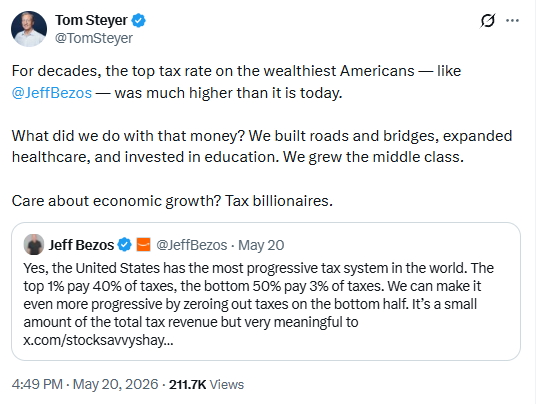
This claim surfaces reliably in every tax debate, deployed to suggest that returning to 70 or 90 percent rates would solve all our fiscal woes. Salmon takes that logic apart:
In 1952, the federal government raised 18 percent of GDP in tax revenues. This compares with federal revenues of 17 percent of GDP today. So, relative to today, “all that money” amounted to only about 1 percent of GDP in federal revenue, roughly $300 billion in today’s economy, or about 2 weeks of current government spending.
On the spending side, Steyer credits those high-rate decades with building roads, funding health care, and investing in education, but the numbers don’t line up.
…Adjusting for inflation, in 1979, the federal government spent $222 billion on all health care programs. Compare this to the FY 2025 budget which allocated $1.66 trillion to Medicare and Medicaid combined, or more than 7-times the amount in 1979.
…For transportation and education spending in 1979, the federal government spent roughly half as much on both as it does today, adjusting for inflation. Even if we adjust for population growth, the federal government still spends significantly more today on transportation, education, and especially on health care.
In other words, the spending buildup happened after rates fell, not during the era of confiscatory rates.
But the most revealing data in Salmon’s piece concerns effective rates, what the wealthy actually paid versus what the statute said:
In 1952 when the top income tax rates were 92 percent, the top 1 percent paid an effective rate of less than 17 percent, while the top 0.1 percent paid a 21 percent effective income tax rate. Today, both the top 1 percent and 0.1 percent pay effective income tax rates above 26 percent. So, with a top rate of 37 percent, the wealthiest Americans pay higher effective income tax rates than they did with a top rate of 92 percent.
The reason is straightforward. The mid-century tax code offered a menu of alternatives. Wages faced a 92 percent rate, corporate income was over 50 percent, and capital gains 25 percent. Naturally, taxpayers took their income in whichever form was cheapest.
We’ve covered this dynamic before (see here and here). Taxpayers in that era simply routed their income through corporations and capital gains to avoid the top brackets entirely, assisted by a complex web of deductions and workarounds that made the avoidance more tolerable. This CBO heatmap below makes the pattern visible:

The dark upper bands (rates above 50 percent) cover only a thin sliver at the very top of the chart before largely disappearing as rates came down. The color that dominates across the whole period is yellow, the lower brackets. The exception is the inflationary 1970s, when bracket creep pushed ordinary workers up the rate schedule. That is when the upper bands briefly widened. The top rates raised revenue in that decade by taxing the middle class, not the wealthy.
Taxpayers revolted. The inflation-fueled bracket creep of the 1970s sparked the Reagan Revolution, drove rates down, and produced indexed brackets. The result was a more friendly, progressive tax code – rates came down for the middle-class and the wealthy shouldered a higher percentage of the tax burden.
Ironically, today’s leading advocates for higher wealth taxes often acknowledge this dynamic, albeit inadvertently. In an NYT op-ed backing California’s proposed billionaire wealth tax, Berkeley economists Emmanuel Saez and Gabriel Zucman repeatedly describe how wealthy taxpayers restructure income, relocate, and otherwise respond to tax incentives. The piece spends multiple sections rebutting concerns about billionaires leaving California, while simultaneously documenting how many have already begun “making moves to leave the state.”
That’s the entire point. The history of the 90 percent era was never one of the wealthy dutifully paying confiscatory rates. It was one of avoidance and behavioral response. Salmon’s piece strips away the mythology and focuses not on headline rates, but on what taxpayers actually paid.