
Jeff Bezos sat down with CNBC’s Andrew Ross Sorkin this week and spent the better part of an hour challenging the political dogma that taxing the rich is the answer to all our country’s economic problems. It’s worth watching, if only to see Sorkin, who specializes in interrupting his guests, barely get a word in during the entire interview.
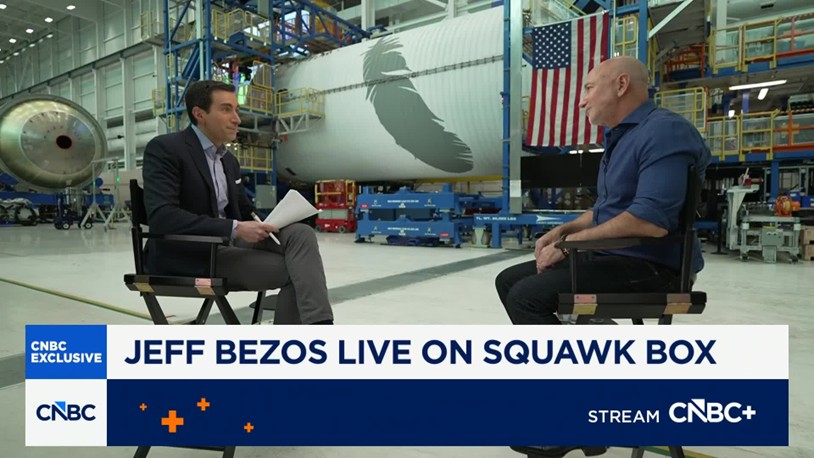
Right out of the gate, Bezos addressed the flawed wealth inequality narrative underpinning much of today’s tax-hike movement:
What’s happening here is politicians are using… this age old technique of, you know, picking a villain and pointing fingers. But the problem is that doesn’t solve anything. And so like, if you want to help the group of people who are struggling, you have to figure out real root causes and solutions. And that takes skill.
…If you really are being honest about it, we don’t have a revenue problem in this country. We already have the most progressive tax system in the world. The top 1 percent of taxpayers pay 40 percent of all the tax revenue. The bottom half pay only 3 percent… We actually have a spending problem and that’s a skills issue.
Bezos used the New York City school system as a prime example of the challenge:
They spend $44,000 per student. That’s 30 percent more per student than other big cities like Chicago, LA, and Boston. And it’s three times more than Miami and Houston. And by the way, New York City doesn’t get better outcomes. If we ran Amazon the way New York City runs their school system, your packages would take six weeks to arrive. We’d have to charge you a $100 delivery fee. And then when the package did finally arrive, it’d have the wrong item in it anyway.
As we’ve pointed out repeatedly, federal tax revenues are currently above historic levels and the tax code is more progressive (the rich pay more) than at any time in the last 60 years. Yet some still want more – always more. At what point can we admit we have a spending problem?
Bezos also addressed the so-called “buy, borrow, die” strategy that has become a fixation of tax hike proponents in recent years:
As far as I know, there is no truth to this ‘buy, borrow, die’ thing. I don’t even know where this comes from. I’m selling Amazon stock routinely, and that’s how I fund Blue Origin and a bunch of other things. So every time I sell I pay taxes on that…I’m a little skeptical that’s a true loophole. But if it is we can fix it. But when you fix that loophole, it’s not going to help that nurse in Queens. It’s not going to help her at all.
As we wrote previously, is any tax avoidance plan in which the taxpayer has to die to benefit really that great?
One of the comments that got the most attention was Bezos’ call for eliminating taxes on lower- and middle-income taxpayers:
A nurse in Queens who makes $75,000 a year pays more than $12,000 a year in taxes. Does that really make sense? So, people talk about making the tax system more progressive. How about we start by having the nurse in Queens not pay taxes? That’s $1,000 a month that could help with rent or groceries or anything. And by the way, do you know what that all adds up to? The bottom half of income earners in this country pay only 3 percent of the taxes. It’s only 3 percent. We can find 3 percent. It’s a small amount of money for the government.
Couple problems here. One, we’ve already eliminated income taxes on families making around $75,000. The combination of the increased standard deduction and the larger child credit means a family of four earning that amount owes maybe a couple hundred dollars, while a single mom with two kids would owe only around $1,000, or $11,000 less than Bezos’ claims.
Two, the real tax burden on the middle class these days are wage taxes to cover Social Security and Medicare. In Bezos’ example, that’s likely the source of the $12,000 tax bill. But those taxes pay for very progressive benefits to the same group of people, while taxing all the billionaires on all their wealth would not cover the cost of those programs. What to do? Check out this solution.
Back to Bezos’ broader point — the federal government wastes enough money that it could afford to stop taxing lower-income earners without reaching further into anyone else’s pocket. He made this explicit when Sorkin pressed him, responding: “You could double the taxes I pay and it’s not going to help that teacher in Queens, I promise you.”
The irony that this clear defense of Main Street comes from the world’s wealthiest person is not lost on us. But the reality is that endless tax hikes are not a substitute for effective governance, and punishing capital does not help the people politicians claim to represent. S-Corp has been making that case for years. It’s nice to hear a rich guy step up and make it too.