
Earlier we highlighted research showing how well the United States is doing compared to Canada. Starting in a similar place forty years ago, today’s American worker earns more and benefits from significantly higher levels of business investment. It’s a gap that is large and growing.
Today we’ve got another geography-based point to make, courtesy of the Wall Street Journal and economists Eric Zwick and Owen Zidar (both of whom spent their formative years getting called last during roll call). Their book “The Everywhere Millionaire” reviewed America’s growing ranks of job creators and discovered the American Dream is alive and well:
Across America, such business owners, we call them Everywhere Millionaires, have built extraordinary fortunes running ordinary businesses. Some launched their own ventures, working long hours and reinvesting the profits to stay afloat and grow. Others inherited a family firm and built upon the success of prior generations.
How many? Zwick and Zidar estimate there are three million of them, collectively worth more than $65 trillion. These are veterinarians, HVAC contractors, and restaurant owners. Nearly half of the nation’s $31 trillion in private business equity resides in what the authors call “tactile, Main Street industries,” businesses where something needs to be “physically moved, or get fixed, served or installed.”
The geography here is striking. The Journal’s map uses Zwick and Zidar’s data to show average pass-through income among upper-income filers on a county-by-county basis. The wealth isn’t confined to a handful of coastal enclaves. It stretches across the country, with Walker County, Alabama topping the map at an average $1.9 million.
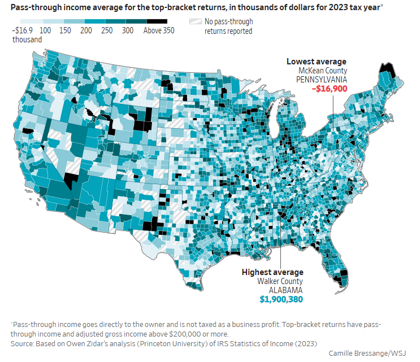
Look familiar? It should. Several years ago we asked EY to map employment at private companies across the country. The result was equally striking. Outside a relatively small number of coastal and urban areas, private companies dominate the employment base.

Combine the two maps and you get a pretty good picture of the Main Street economy. Private businesses provide the majority of jobs in this country — nearly four out of five. Our EY map shows those jobs are widely dispersed across the country, while the WSJ map shows the same goes for the wealth they generate – it’s spread across communities far removed from the usual financial and technology hubs.
The examples bear that out. Dick Portillo turned an $1,100 hot dog stand outside Chicago into a billion-dollar business. A.B. Walters built a gutter manufacturer in Natchez, Mississippi. Arch “Beaver” Aplin III built Buc-ee’s in Texas.
In recent weeks, we’ve seen a wave of proposals to raise taxes on these businesses – here, here, and here – often accompanied by the mischaracterization that the targets are primarily “law firms and hedge funds” whose income is unearned and whose wealth resides in an off-shore bank account somewhere far away.
The “Everywhere Millionaire” makes clear just how false that narrative is. The income came after decades of hard work, and the wealth is right here in the communities where we all reside and work. That’s the reality of wealth in America, and the reason voters need to reject efforts to tax wealth, these businesses, and your job into oblivion.