
A decade ago, Treasury published a paper on effective tax rates that was worth a hard look. As our write-up showed, the headlines generated by the paper were not justified by its actual findings.
We’re republishing that response today because the original Treasury paper is back in the news – it’s cited in a recent NYU-Hamilton paper on pass-through businesses and two of its authors also co-authored the “Everywhere Millionaire,” a book which – as we explained the other day – is generating similarly misguided news coverage today.
New Treasury Effective Rate Study
Economists at the Department of Treasury and NBER last week released a paper reviewing the average taxes paid on business income, by entity type. We went through a similar exercise several years ago (you can read our study here), so we printed up a copy and took a look.
Here’s the headline graph:
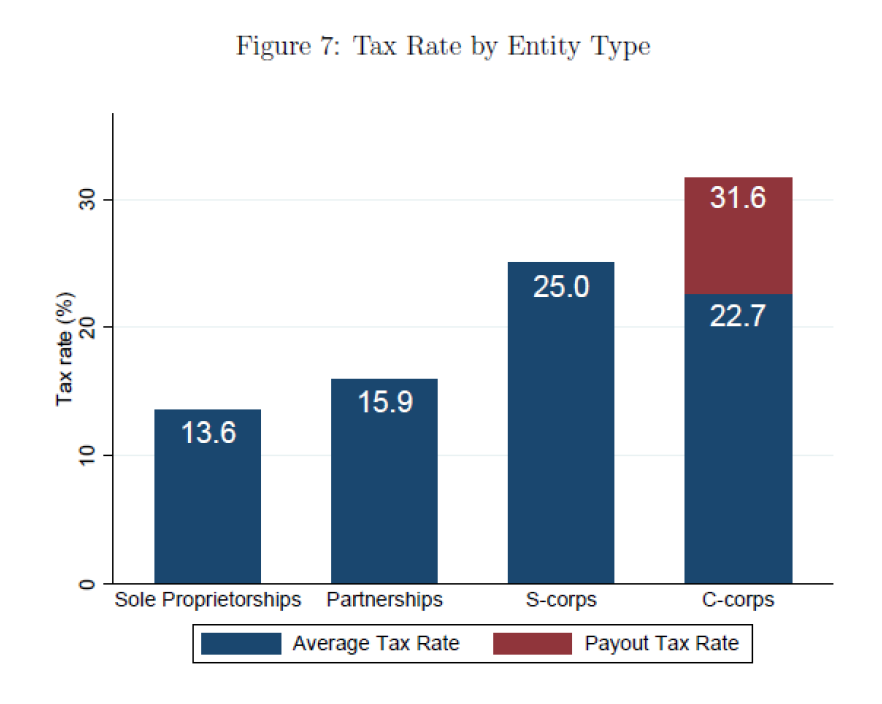 As you can see, the average tax rates for S corporations and C corporations are in the same basic range, while the averages for sole proprietorships and partnerships are significantly lower. The lower partnership average, coupled with the paper’s obvious emphasis on income inequality and the prospect of new revenues has garnered the majority of the press surrounding the paper’s release.
Below we itemize our initial thoughts regarding the substance of the paper and the quality of the estimates. But let’s face it—those items are secondary to the real point of the paper, which is to drive headlines like these:
“Pass-throughs to blame for income inequality?” — Politico
“Corporate ‘Pass-Throughs’ Have Cost the Treasury $100 Billion” – The Fiscal Times
Those headlines are based on the paper’s abstract and the general write-up, which emphasizes two basic points:
- The pass through structure contributes to income inequality; and
- Treasury would collect $100 billion more a year in revenues if C corporations were still the dominant entity type, as they were pre-1986.
The first point was summarized neatly in a Politico blog post last week:
PASS-THROUGHS TO BLAME FOR INCOME INEQUALITY? A new report by a group of Treasury Department economists and academics says the rise of business pass-throughs is a major contributor to income inequality. Pass-throughs paid an average tax rate of just 19 percent in 2011, the analysis found, compared with the 31 percent rate paid by traditional corporations. At the same time, their income accrued disproportionately – 69 percent – to the top 1 percent. “As is well-known, the top-1 percent income share doubled (from 10 percent to 20.1 percent) between 1980 and 2013,” the report said. “Less well-known is that over half (56 percent) of that increase came in the form of higher pass-through business income.”
Both Treasury and Politico have it exactly backward. Pass through taxation doesn’t add to “income inequality.” C corporation tax treatment masks it. This is something we have written about in the past.
Take Warren Buffett. He owns a large share of Berkshire Hathaway. That corporation pays no dividends and Buffett never sells any stock, so if one was just looking at the tax rolls, Buffett’s reported income is relatively low despite the fact that he’s one of the richest men on the planet. All his income is effectively hidden within Berkshire’s corporate structure. Treasury touches on this dynamic in a footnote at the bottom of page 2:
Note that this evidence may seem to suggest at first glance that at least a portion (e.g., perhaps 56% x 35% = 20%) of the rise in the top-1% income share could reflect merely a change in how business income is reported on Form 1040 returns: before annual business income taxes (as pass-through income subject to ordinary individual income taxes) rather than after annual business income taxes (as post-corporate-income-tax dividends or capital gains distributions).
Figure 2 at the back of the paper helps illustrate this dynamic.
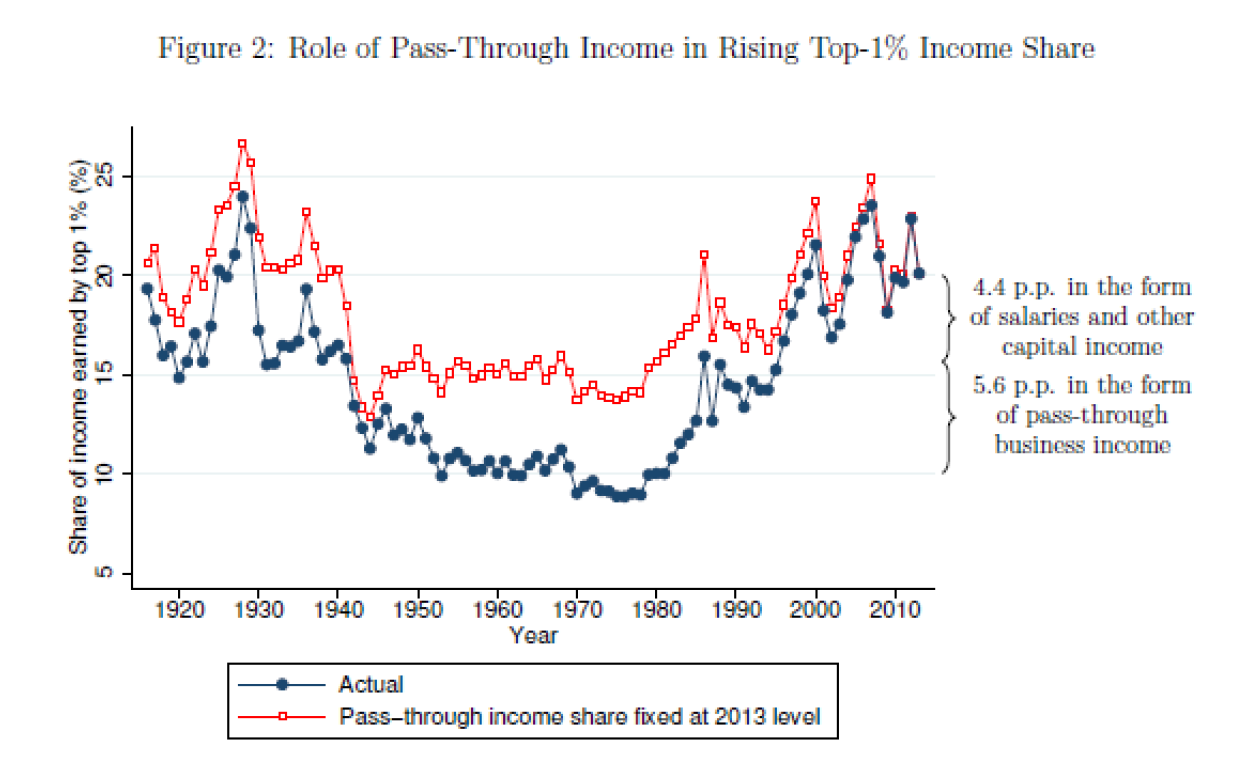
The blue line shows the rise of income inequality, thanks to data from Piketty and Saez. The red line shows how much less inequality would have risen if businesses back in 1980 were taxed as businesses in 2013 – i.e. all that income showed up on the individual tax forms rather than the corporate ones. Lesson: C corporation taxation masks income inequality.
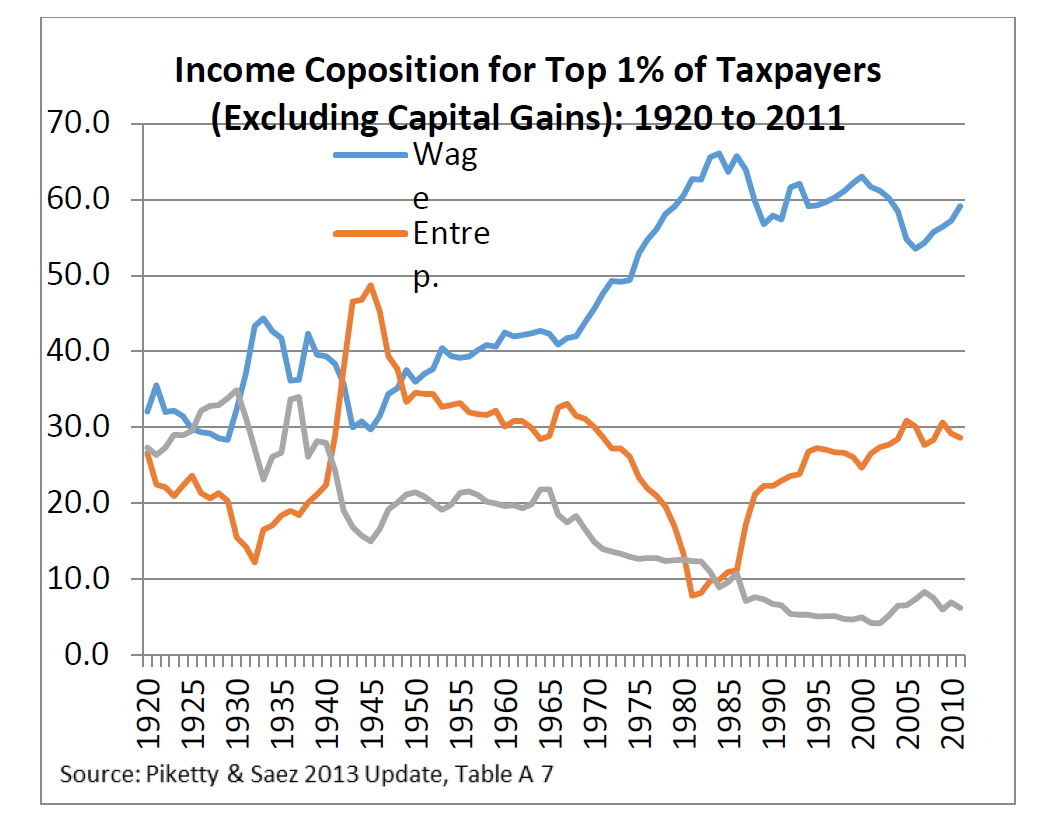
Here’s the underlying data from Piketty and Saez. Notice how the “entrepreneurship” income bottoms out right when Ronald Reagan began cutting marginal rates on individual and pass through businesses in 1981? A large part of the perceived growth in upper incomes is really just an accounting shift from corporate to pass through tax reporting.
The second assertion is that Treasury would collect $100 billion per year in revenues if C corporations were still the dominant business type. Here’s the study:
If pass-through activity had remained at 1980’s low level, strong but straightforward assumptions imply that the 2011 average U.S. tax rate on total U.S. business income would have been 28% rather than 24%, and tax revenue would have been at least $100 billion higher.
We’ve pointed out in the past that the migration of businesses from the inefficient corporate tax to the more efficient (and equitable) pass through structure has been a boon to the American economy and workers. As our 2011 EY study made clear, there are more businesses, higher levels of capital, and more jobs because of pass through taxation.
Measured against the overall economy, the business sector today is literally bigger than it was before the 1986 tax reform opened the door to pass through taxation. Tax Foundation numbers show that business income made up 9 percent of GDP pre-1986 (8 percent corporate income and 1 percent pass through). Today, business income makes up 11 percent of GDP (5 percent corporate and 6 percent pass through).
So if you are going to revert back to pre-1986 shares of business income, don’t you need to revert to the smaller economic footprint as well? That would mean expanding the application of the corporate tax to more business income, but also shrinking the total business tax base by about 20 percent. That adjustment would effectively wipe out any prospective revenue gain. Add in today’s higher tax rates on pass through businesses and it is possible the Treasury approach would lose revenue.
The study recognizes the inherent weakness of the $100 billion estimate:
We stress that this exercise is not a projection for the likely effects on tax revenue from business tax reform. It is mechanical and assumes no behavioral responses, but has the advantage of being transparent.
Transparent it might be but, unfortunately, this nuance was lost to the popular press. Beyond these two key points, here are other thoughts regarding the report:
- The new study uses 2011 filings and tax rules, so it misses the sharp rate hike on pass through businesses that took effect in 2013. That change alone should dramatically raise the resulting effective rates on S corporations and partnerships.
- Despite employing pre-2013 rates, the study finds that S corporations pay the highest average tax on their income (25 percent vs. 22 percent for C corporations) before shareholder-level taxes are factored in.
- The study then assumes shareholder-level taxes add another 9 percentage points to the C corporation average rate, but that assumption is based on economic literature from 2004 rather than tax collections from 2011. It also employs heroic assumptions about the composition of corporate distributions (Footnote 16). Definitely worth further review.
- For partnerships, the study fails to differentiate between active business income and investment income, which is obviously taxed at lower rates. The study notes that 70 percent of partnerships are “finance and holding companies.” To the extent these partnerships are investing in C corporations whose income is already taxed at the entity level, it makes sense that their effective tax rate would be lower than the top statutory rate. Perhaps this partnership income should be included in the C corporation bucket, since they are C corporation shareholders?
- The study attributes twenty percent of the partnership income to “Unidentified TIN type” and “Unidentified EIN.” It then appears to assume this unidentified income was taxed at a blend of the two lowest applicable rates, resulting in an even lower average rate for partnerships. As with the C corporation shareholder assumptions, definitely worth a further look.
These are just our initial reactions to the Treasury report. We will have more to say in the future. The report was written by serious people and it deserves a serious response. But the news cycle doesn’t follow the academic calendar, and the study’s emphasis on income inequality and revenue gains are driving numerous news stories today. So it was important to remind our members that this study is not the last word in pass through taxation.