
Senators Elizabeth Warren and Bernie Moreno recently proposed lifting the Social Security wage cap to address the program’s pending insolvency. It’s the lazy solution (i.e., throw more money at a problem, declare victory, move on) and also the wrong approach.
Tax expert (and friend of the podcast) George Callas has an excellent writeup on this, along with his thoughts on what Congress should actually be considering.
Nixing the cap would impose a massive marginal tax increase (12.4 percent) on wages above the current $184,500 threshold. That increase would come on top of existing federal, state, and Medicare taxes, and apply to millions of S corporations and other pass-through businesses as well as individual workers. George summarizes the result:
Along with the 3.8% Medicare payroll tax, such a change would push the top federal tax rate on labor above 50% — above 60% when including the state income taxes of high-tax states. That’s a recipe for less work, lower wages, and lower tax revenues
And we have a pretty good idea of just how damaging those higher rates would be. As George notes:
In its recent tax reform options guide, the Tax Foundation provided estimates of two payroll tax increase proposals that, when combined together, we can use to approximate the negative economic impact of such a large marginal tax rate increase on high-wage skilled labor:
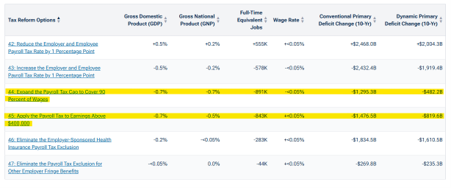
The two highlighted options would expand the payroll tax cap to cover 90 percent of wages and then apply the tax again to earnings above $400,000. And the results aren’t pretty. Back to George:
Taken together, the Tax Foundation projects that these two tax increases would raise nearly $2.8 trillion over ten years on a conventional basis, but only $1.3 trillion on a dynamic basis. That’s because this pair of policies would reduce employment by a combined 1.7 million full-time jobs (!) and would reduce GDP by 1.4%. (Emphasis added.)
That’s the problem in a nutshell. If enacted, the policy yields a smaller economy and nearly two million fewer jobs, with more than half of the anticipated revenue disappearing in the process. Not exactly a “fix.”
George spends the balance of his piece exploring what a more thoughtful solution might look like, including benefit reforms, a more targeted revenue component, changes to the taxable wage base, and income tax relief designed to mitigate the economic harm from higher payroll taxes. There’s a lot more to it, and we’d encourage readers to check out the full piece for the details.
As we wrote earlier this year, wage taxes are particularly destructive. Workers ultimately bear their cost through lower wages and higher rates of unemployment. These taxes impose huge costs on employers too, as they are forced into the role of tax collector for the IRS. That means policymakers should be looking for ways to reduce our reliance on wage taxes, not dramatically expand them.
One option is to swap the payroll tax for a VAT or other broad consumption tax. It sounds like a radical departure from the current system, but there’s a healthy body of economic literature behind the idea. Studies examining shifts from payroll taxes to consumption taxes have found they can increase employment, improve work incentives, and raise wages, all while preserving the revenue needed to fund the program.
There’s no shortage of good ideas for fixing Social Security. What they have in common is a recognition that the economic effects of reform matter, and that Congress has options beyond simply cranking up the tax rate on wages and Main Street businesses.