
S-Corp has argued that fixing Social Security’s pending insolvency will require some creative thinking, including scrapping outdated, harmful wage taxes. They were a bad idea when Social Security was created, and they’re an even worse idea now. It’s an aggressive approach, but given the size of our fiscal challenges, now is the time for aggressive policies.
A recent op-ed by Senators Elizabeth Warren and Bernie Moreno moves in the opposite direction by subjecting all wages to the Social Security tax. It seeks to “fix” the problem of Social Security insolvency the way Congress always has – by throwing more money at it.
As noted by the Tax Foundation, this massive rate hike might reduce some of the Social Security deficit, but it also would result in a smaller economy, fewer jobs, and less revenue than what the proponents expect. What’s more, it would take us full circle, resurrecting the broken tax code that existed in the 1950s and 1960s, when individual rates were really high and the wealthy paid much less in taxes. Here’s why.
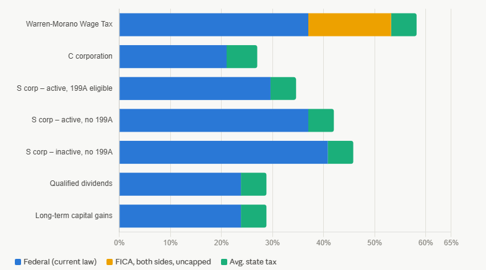
Lifting the Social Security wage cap would impose a 12.4 percent rate hike on anyone making more than $184,500 a year in wages. This increase would be on top of existing income taxes, including the Medicare tax (up to 3.8 percent), the federal income tax (up to 37 percent), and any applicable state and local taxes. Add all that up and a worker earning $200,000 would see their marginal rate rise to over 40 percent. Top earners would pay around 60 percent.
Meanwhile, tax rates on corporate income and capital gains would stay the same. You can see the problem here:
Rates this divergent are simply unsustainable. We’ve seen gaps like this before and two realities emerged – first, the wealthy paid little in taxes, far less than they do today. The most recent estimates have the top one percent paying 38.4 percent of all individual income taxes, whereas the same group paid only 25.8 percent pre-1986 tax reform.
Second, pre-tax reform those wealthy taxpayers used C corporations and other means to shelter their income and avoid the higher rates.
In the 1960s, the top tax rate on wage income was 70 percent while the top corporate rate was 46 percent. That 24-percentage point differential encouraged high income taxpayers to form corporations to delay realizations and access the lower corporate rate. They also loaded up the business with all sorts of questionable expenses. The goal was to shift as much income into the corporation as possible while using deductions and credits to minimize how much was subject to tax. As Douglas Sykes noted at the time:
[C]ommon tax planning techniques which might be employed to lessen the impact of federal income taxes… include, 1) tax motivated incorporations, 2) utilization of the maximum tax on personal service income, 3) income averaging, 4) the use of tax-sheltered transactions, and 5) nonqualified deferred compensation plans.
The rate differential under Warren-Moreno would be bigger – they would impose a top federal rate over 50 percent on wages while taxpayers organized as C corporations would pay just 21 percent. Guess where the money is going to go? The bigger the tax rate gap, the more pressure taxpayers feel to shift income into C corporations and other forms of income that allow for deferral and, ultimately, a lower rate.
This isn’t just a C corporation issue. The proposal would put enormous pressure on the pass-through structure as well. The current rules that apply wage-type taxes (HI, FICA, Self-Employment, NIIT) to the incomes of pass-through owners are a mess and a source of constant debate and tinkering, and that’s with a rate differential of just 3.8 percent for incomes above $200,000. What sort of games would be justified if the differential were 16.2 percent?
What should Congress do? Instead of increasing the tax rate gap, Congress should reduce it by taxing all forms of income once and at the same top rate. The Single Tax System would eliminate incentives to shift income from one place to another while reducing the economic harm caused by the double corporate tax.
Eliminating wage taxes, meanwhile, would free employers and employees alike – workers could keep more of their wages and employers would no longer be unpaid tax collectors subject to enormous costs and risks. Swapping out wage taxes for a VAT, for example, would put Social Security back on a sound footing without destroying the economy.
250 years after the first tax revolt, it’s time for another one. Let’s build a tax code that works for workers and investors alike. Or you could just raise tax rates and hurt everybody. Your choice.