
A new report from the Congressional Research Service (CRS) puts fresh numbers behind a point we’ve made for a decade: Section 199A is essential to keeping pass-through businesses competitive with their C corporation counterparts.
The report examines the effects of increasing the Section 199A deduction from its current 20 percent to 25 percent, which was floated as part of last year’s tax bill debate. CRS modeled that proposal to see how it would affect marginal effective tax rates on new business investment. Their chart shows the results:
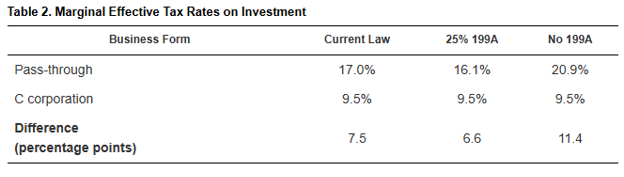
As noted, Marginal Effective Tax Rates (METR) measure the effective tax imposed on new investment. They include all the relevant tax provisions of the tax code, so not just the statutory rate but also depreciation, expensing, interest deductibility, inflation and, importantly, taxes at both the entity and investor level. As such, they are very useful in determining which business structure pays more.
As you can see, CRS’s estimates show the marginal effective tax on pass-through investment is significantly higher than the tax paid by C corporations. As CRS puts it:
Increasing the 199A deduction from 20% to 25% is estimated to reduce the effective tax on new pass-through investment from 17.0% to 16.1%, and therefore would reduce the tax differential across business forms by 0.9 percentage points (or 12%). Table 2 also shows that if there were no 199A deduction, the estimated marginal tax rate on new pass-through investment would be 20.9% compared to the 9.5% rate on corporate investment.
A couple of observations. First, the estimates here explain why Section 199A was enacted in the first place. The TCJA permanently reduced the corporate rate from 35 percent to 21 percent. Section 199A was adopted to help maintain parity between the two tax systems. Or as CRS writes: “The Section 199A deduction promotes parity between the tax burden on corporate and noncorporate profits.”
Without 199A, the effective rate on pass-through investment would be more than double the 9.5 percent rate on C corporation investment. The current deduction narrows that gap substantially, while a 25-percent deduction would narrow it further.
Second, if you’re wondering what’s driving some of the economic consolidation taking place in industries like health care, veterinary, construction, etc., the C corporation rate advantage is a big part of it. Investors use C corporations as the vehicle of choice to funnel their money into the acquiring funds.
So there you have it – still more evidence that, in the search for parity, 199A is essential. In fact, if we wanted to be pedantic, we’d observe that it needs to be higher. Raising the deduction to 25 percent would move the tax code even closer to the parity Congress sought when it created 199A.