
As we previewed recently, the House Financial Services Committee yesterday advanced legislation that would repeal the Corporate Transparency Act’s reporting requirements for over 30 million American businesses. The measure – as amended and approved by the panel – codifies a Treasury Department rule limiting the CTA’s scope only to foreign entities, while protecting sensitive information already collected under the state by requiring a purge of the beneficial ownership database.
It’s a huge win for the tens of millions of Main Street businesses targeted by this ill-conceived reporting regime, and marks a new milestone in our efforts to rein in one of the most sweeping data collection mandates ever conceived. Better still, it appropriately applies a risk-based approach to enforcement that shines a spotlight on bad actors, not law-abiding Americans.
So why was this action necessary? Here’s the bill’s sponsor, Representative Warren Davidson:
We’ve heard from small businesses and individual citizens from around the country who have been shocked to find that their small business is presumed to have committed a crime. Therefore, they’re essentially being served a search warrant…This is the most poorly thought out, poor structured approach that I could think of.
What we need to do today is lock in the rulemaking that the executive branch has done. They’ve had the notes of proposed rulemaking. They’ve had massive feedback. And the feedback overwhelmingly says that the people want to they want to they want to they want security, but they also want privacy, just like the Founding Fathers did. And that’s why our Constitution’s structured the way that it is. So I think the Administration’s thoughtfully addressed this, and now it’s our burden to do this with lawmaking.
Chairman French Hill later shared his thoughts:
Let’s start out with some basic principles here. First, it is illegal to do money laundering, illegal to structure transactions, illegal to hide money through the American corporate system. And we have a rule on that that’s been in place since 2016, the Customer Due Diligence rule, where every bank already collects the beneficial ownership information for everyone who has a business entity in the company.
Second, the impact on the small business community: 33 million businesses have to comply with the rule as designed…we’re asking Joe’s HVAC company to go through the process of complying with a form with a government entity he’s never heard of, filling out another form that could be a database that could be leaked. As passed by Congress, this act imposed an onerous, confusing, duplicative filing requirement on small businesses.
If we limit the beneficial ownership database to foreign actors… aren’t we marshaling our resources directly at the people we suspect of tax evasion or human trafficking or money laundering? I think it better focuses federal resources, and I think it’s more fair to our small businesses.
Longtime S-Corp ally Carol Roth also weighed in to urge lawmakers to advance the measure:
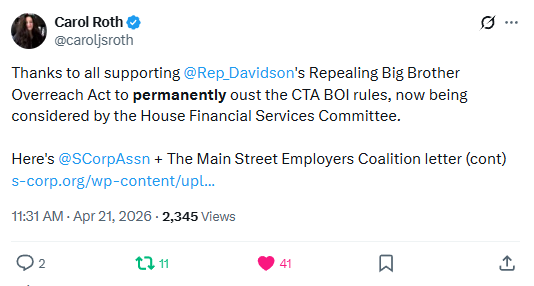 In short, today’s markup reflects that sustained advocacy and a growing recognition in Congress that the CTA’s reporting regime misses the mark.
The bill now heads to the House floor, where lawmakers will have another opportunity to deliver meaningful relief to Main Street while preserving the tools needed to combat illicit finance. We’ll be urging lawmakers to act swiftly and hope you’ll join our efforts.