
A new paper out of the Tax Policy Network on the “one-time” California wealth tax initiative highlights just how untethered the proponents’ revenue estimates are from reality. The assumptions driving the initiative are so thin, they call into question whether this initiative is designed to raise revenue, or simply punish rich people.
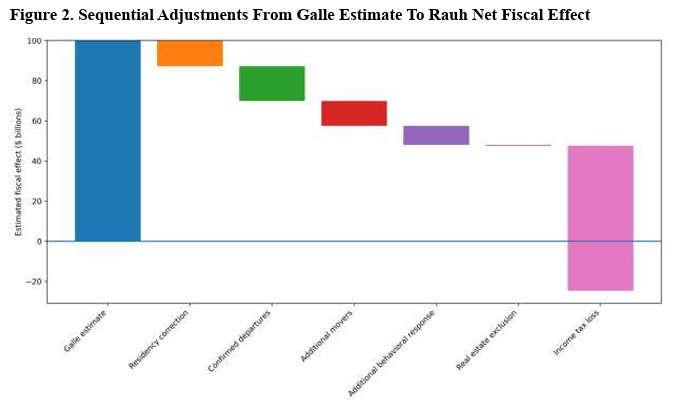
Here’s the key graph:

Where do the estimates come from? The group of economists who helped construct the wealth tax proposal used a back-of-the-envelope calculation to estimate how much revenue it would raise: they started with the Forbes billionaire list to guesstimate how much wealth is held by the targeted billionaires, subtracted 10 percent for tax “avoidance and evasion,” and multiplied by 5 percent. The result was a revenue estimate of nearly $100 billion.
A competing analysis using real analytic tools showed a much smaller tax haul — negative, in fact, if you include the anticipated deterioration of the income tax base.
Who’s right? You decide.
Here’s the complete analysis from the wealth tax advocates, which includes our old friend Emmanuel Saez:
The Forbes billionaire list has 213 California billionaires with a collective wealth of $2.182 trillion (which is 26.6% of the US wide $8.189 trillion owned by all 938 US billionaires). A 5% tax on $2.18 trillion raises $109 billion. Factoring in 10% of tax avoidance and evasion leads to a scoring of $99 billion that we round to $100 billion for simplicity.
That’s it. This is the analysis that is going to cost California billions, whether it passes or not, and they couldn’t even be bothered to toss in a couple of footnotes?
Contrast those three sentences with the work of Rauh, et al. They also start with the Forbes list but then adjust to reflect residency and other factors. They then:
- Subtract the value of residential real estate (exempt under the proposed tax).
- Subtract those billionaires who have already left the state.
- Subtract the anticipated behavioral response of the targeted billionaires, including relocation, tax planning, and avoidance.
The result is a projected revenue gain of just $40 billion, or less than half what the voters of California are being promised. But that’s just the wealth tax side of the analysis. What impact does the resulting migration and tax avoidance have on other taxes?
The authors estimate the income taxes paid by the targeted billionaires and then calculated the net present value of the taxes no longer paid by those who leave the state or otherwise change their behavior. Applying “reasonable assumptions about discount rates, mobility effects, etc.,” they conclude that the next present value of the wealth tax could be negative.
So California’s one-time wealth tax could result in a permanent loss of revenue to the state. Instead of helping reduce the state’s budget deficit and lower the burden on the middle class, the initiative will do the opposite. Revenues from the rich will fall and the middle class will be left to pay the difference. Meanwhile, all those wealthy taxpayers will be sunning themselves in Florida and Texas, paying no income tax whatsoever, and not being punished at all.