
Is there a penalty for bad reporting? This week’s WSJ article entitled “The ‘Buy, Borrow and Die’ Wealth Strategy Has Become a $5 Trillion Market” makes a strong case that there should be. Here’s the lede:
Buy, borrow and die is a mantra of the rich. They love to take out loans against stock they own, so they don’t have to sell it when they want to buy other things such as mansions, yachts and movie studios.
Lots to unpack here. Start with the label. “Buy, Borrow and Die” is a misnomer. The phrase describes a supposed strategy employed by rich people to avoid capital gains tax by borrowing against their appreciated assets. That last qualifier is the key – the assets employed must have appreciated during the borrower’s ownership – otherwise there’s no tax advantage. The label also fails to capture the fact that interest must be paid on the loans as well as the estate tax implications of all this.
Put it all together and a more accurate label would be, “Earn, Save, Invest, Grow, Borrow, Pay Interest, Repay the Loan, Die, Pay the Estate Tax.” Doesn’t sound like as much fun, does it?
How big is this lending market? The headline suggests it’s $5 trillion, but that number quickly falls apart. It’s a Deloitte estimate of securities-backed credit worldwide, with only around “30% of the market is estimated by Deloitte to be in the U.S….”
So 30 percent of $5 trillion, or $1.5 trillion? That’s just 1 to 2 percent of total public securities held in the US. – hardly a widespread practice. But it’s smaller than that:
Actual borrowing may be lower because customers don’t often fully draw on their credit lines. Deloitte estimates that actual borrowing against credit lines might be closer to $1.6 trillion.
So not $5 trillion, not $1.5 trillion, but rather $500 billion. That’s one-tenth the headline number. And the introduction of “lines of credit” into the discussion seems significant. Most businesses employ lines of credit to ensure that, if they run into cash flow issues, they can stay liquid and make payroll. Are we talking about those kinds of loans here?
More on the size question. A recent paper by economists from the Michigan and Yale Law Schools looked at how prevalent borrowing was for all income classes. The key graph is below, comparing levels of debt to aggregate unrealized gains.
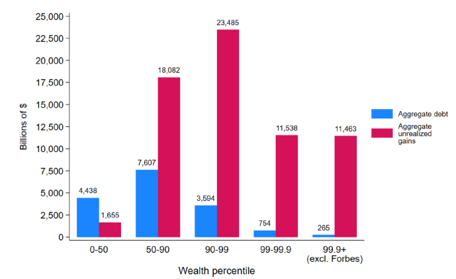
What do we learn? For the wealthiest Americans, debt is a tiny percentage of their unrealized gains, suggesting that “Buy, Borrow and Die” is more of a pithy catchphrase than a real issue requiring a legislative response. The real BBD activity is taking place in the middle-class, where families borrow against their homes to pay for college, retirement, etc.
Another challenge — the lede suggests these loans are being used for consumption purposes, as in to buy “mansions, yachts, and movie studios.”
But is borrowing money to fund the takeover of Warner Bros. to form Skydance really the same as buying a house or a boat? Since when? And why does the article cite Elon Musk specifically when he famously doesn’t have big, pricey toys?
The piece makes another claim worth exploring – that the BBD strategy is increasingly being utilized by the “less wealthy”? Seems a bit premature to show this much interest in non-billionaires. We haven’t taxed the billionaires yet, and we’re already targeting everybody else?
Even if it’s correct that the BBD strategy is spreading, what’s unclear is whether the trend is driven by a desire to avoid taxes, or because equity markets have swollen in recent years and banks are increasingly open to allowing the use of securities as collateral for loans?
Why would banks do this? Because it’s profitable. From the article – “For purebred wealth managers, such as the traditional Swiss-headquartered private banks run by families or partners for generations, Deloitte said the loans can generate 25% or 30% of annual profit.” Remember, these are real loans that require real interest payments and the eventual repayment of the principal. None of this is acknowledged in the BBD narrative.
To its credit, the article does acknowledge there are other reasons to borrow instead of selling appreciated assets, including to avoid diluting your ownership stake and to avoid the fire-sale of illiquid assets.
Both these concerns apply directly to S corporations. Selling shares of your business is difficult — there’s no ready market for closely-held businesses as there is for public companies. Moreover, diluting your ownership stake below a “controlling interest” might result not just in the loss of control, but also in the loss of value, as a minority interest in a business is worth 30-50 percent less than a controlling stake.
What to do? Borrow instead, if you can.
The “Buy, Borrow and Die” crew isn’t concerned with any of this. Their agenda is to redefine taxable income so they can tax unrealized gains. Not an easy task, but the first step is to undermine the legitimacy of the gains themselves. We used to call such gains savings and viewed them as a good thing. More savings means more capital, more investment, more jobs, and higher wages.
In the post-COVID world, however, promoting private savings is so last century. The government spends $1.40 for every dollar it collects, so it needs the dues. If collecting them means taking a normal business practice and relabeling it a tax dodge, so be it.