
Apollo’s “Daily Spark” had a nice blurb last week featuring the “Everywhere Millionaire.” Here’s what they said:
The income that lifted America’s top 1% did not come mainly from tech or Wall Street, according to The Everywhere Millionaire. More than half of the rise in the top 1% income share since 1985, 5.8 of 10.5 percentage points, flowed through pass-through businesses, see chart below.
The authors, Owen Zidar and Eric Zwick, counted roughly 3 million wealthy private business owners, with average net worth near $25 million, running law firms, car dealerships, medical practices, commercial contractors and regional restaurant chains, the kind of businesses that make their owners wealthy and well known in their own communities without ever making them nationally famous.
And here’s the graph:
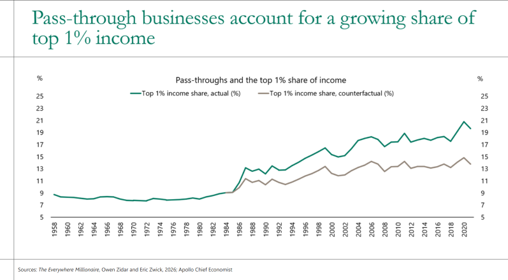
As you know, S-Corp is all about praising Main Street, but is this praise? More importantly, does it reflect reality? The answer is no. That big jump in pass-through income doesn’t reflect a sudden increase in inequality, but rather a massive shift in how businesses accounted for their profits. They gave up using C corporations as tax shelters and began paying taxes using the more transparent, efficient, pass-through structure instead. Here’s what we wrote back in 2019:
The sizable shift in business activity from C corporations to S corporations following the 1986 tax reform had the side effect of artificially inflating income for higher income shareholders. Income that previously appeared on C corporation returns was now showing up on 1040s.
Just how biased was the tax code pre-1986? Very. This table shows just how tilted the playing field was towards C corporations prior to 1986:
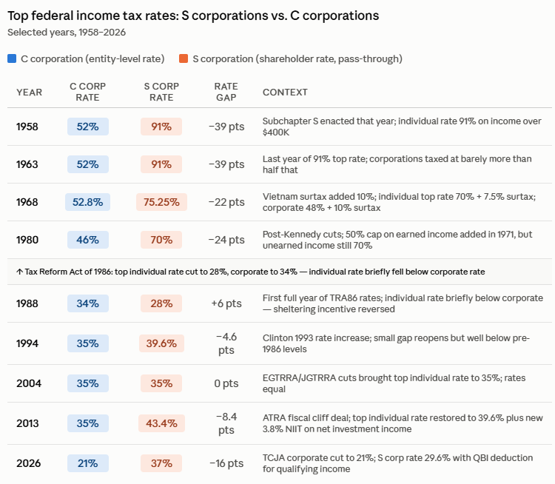
The lesson here is clear – you simply couldn’t maintain a successful S corporation under the pre-1986 pass-through rate structure. The shift in rates post-1986 was less a windfall and more a leveling of the playing field for pass-throughs. In previous work, Eric Zwick recognized the income allocation effects of these changes post-1986.
A considerable part of the increase in the top 1 percent share of income since the 1980s can be accounted for as a shift to the pass-through corporate form, not an actual rise in business income for this group.
Obviously, there is more to the tax parity story than headline top rates, but our work with EY and other groups suggests the current mix of rates, deductions, and growing population of tax-exempt shareholders (for public companies) has resulted in rough parity between large pass-throughs and public C corporations, but only with Section 199A in place. Analysis from Treasury, CBO, and other econometric outfits agrees:
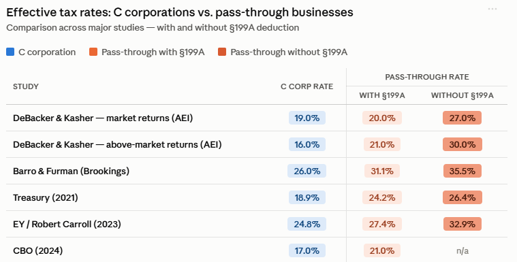
Bottom Line: The suggestion that today’s code is “biased” towards pass-throughs just doesn’t hold up. The pre-1986 code punished successful pass-throughs with confiscatory rates. The 1986 Tax Reform Act and subsequent measures adopted by Congress, including Section 199A, fixed all that.