
This is the second of three Washington Wires covering, in part, a recent paper by the Economic Strategy Group and its reception here in DC. Today’s focus is on the following line from the organization’s website, summarizing the paper by economists Kimberly Clausing and Natasha Sarin:
Clausing and Sarin focus on the tax side of the ledger because government spending today largely finances politically popular entitlement programs, national defense, and interest on prior debt, leading the authors to conclude that there are more politically feasible ways for raising revenue than there are for cutting spending.
So raising taxes is more politically feasible than cutting spending? Couple thoughts.
First, let’s put this whole discussion into context. Here’s the Congressional Budget Office’s latest projection of federal revenues and outlays:
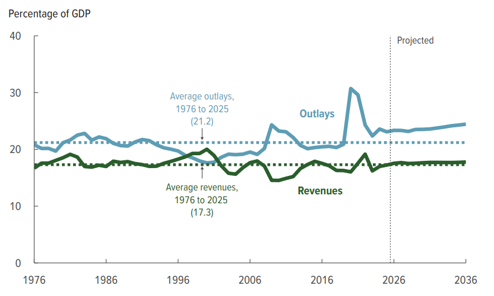
The picture is pretty clear. Federal revenues are above their historical average and projected to rise further. Spending, meanwhile, is well above the 50-year average and is rising even faster. In just ten years, it will be above 25 percent of our national income. There’s simply no way tax revenues can catch up to spending levels that are growing that fast.
Second, you might have noticed a steady stream of stories documenting historic levels of fraud in federal programs lately. We’re talking about organized criminal enterprises, billions in fraudulent claims, and safeguards that appear to have been designed on the honor system. Here’s just a sample:
- Arizona’s sober-living scandal: Investigators uncovered approximately $2.8 billion in fraudulent Medicaid billing involving bogus treatment facilities that exploited vulnerable patients, including Native Americans.
- Minnesota’s social-services scandals: The Feeding Our Future scheme involved approximately $250 million in fraudulent claims for meals intended for needy children, while a separate housing assistance program ballooned from a projected $2.5 million annually to $104 million amid widespread fraud allegations.
- Los Angeles hospice fraud: According to the Oversight and Government Reform Committee, Medicare lost an estimated $3.5 billion from fraudulent reimbursement payments just in Los Angeles County. The county has about 1,800 hospices, nearly one-third of all hospices in the country, and state auditors flagged 700 of them for fraud indicators.
- Ohio home-health fraud: A House Oversight Committee letter noted reports estimate that fraud in Ohio’s HCBS waiver program is potentially over $1.2 billion. In June, federal officials in Columbus announced indictments of 14 people accused of stealing $50 million from taxpayers.
- Medicare and Medicaid fraud: DOJ’s 2025 enforcement sweep charged 324 defendants in schemes involving $14.6 billion in alleged intended losses, including $2.9 billion in actual losses.
What does this all add up to? In 2024, the Government Accountability Office released its first government-wide estimate of fraud, concluding that federal agencies lose between $233 billion and $521 billion annually to fraudulent activity. That’s between 3 and 7 percent of average federal obligations.
Now go back to the Economic Strategy Group’s assertion that cutting spending is simply too difficult. Are they kidding?
Fraud in federal programs is corrosive. It undermines public confidence, steals resources from the people who need the help, and punishes honest providers who follow the rules. When a dishonest operator bills Medicare for nonexistent care, taxpayers, legitimate providers, and patients all pay the price.
And since this is a blog about tax policy, let’s talk about who ultimately foots the bill. Every dollar lost to fraud is another dollar the Treasury must collect in taxes. A large part of that burden falls on Main Street businesses whose owners are already heavily taxed.
When their taxes go up to pay for all this fraud, what gets cut? Higher tax rates discourage the work, investment, and business expansion that feeds our economy. And with spending growing faster than revenues, each successive tax increase merely postpones the next fiscal reckoning.
So the next time somebody says that it’s just too tough to cut spending, think of this — unless Congress brings spending under control first, all the taxes in the world won’t fix our fiscal challenges.