
One of the of the more entertaining aspects of today’s election news is the insistence on branding Abdul El-Sayed, the hard-left winner of yesterday’s Michigan Democratic Senate primary, a mere “progressive.” Meanwhile, his more traditionally progressive opponent, Haley Stevens, has been recast as a “moderate.” More moderate than El-Sayed, certainly, but…
With that as a conversation starter, here are some take-aways from yesterday’s remarkable primary election.
The Goal Posts Have Shifted
The most obvious take-away is how the goal posts have shifted on what counts as “mainstream” these days. The New Republic published this eye-opening piece just yesterday about how Senator John Fetterman (D-PA) is now on the outside looking in if Democrats win the Senate:
Fetterman noted that he agrees with the Democrats on the vast majority of policy issues. But based on his public comments, the senator seems fixated on two particular matters: Israeli-Palestinian policy and the progressive-socialist left. And on those two matters, the divide between Fetterman and the Democratic Party is huge and growing. The Democratic left that Fetterman goes on Fox News to bash is surging in numbers and power—in no small part because of the status quo that Fetterman has done much to uphold. Antipathy toward Israel has expanded from progressive politicians to even average Democratic voters.
Senator Fetterman is no longer a Democrat in good standing because he isn’t a socialist and supports Israel?
The Polls are Still Wrong
Meanwhile, the polls continue to be unreliable. El-Sayed won yesterday, but not by nearly as much as predicted. Granted, polling in primaries is difficult because turnout varies significantly. That’s compounded by states with open primaries, like Michigan, where Independents and even Republicans can switch over and vote in the Democratic race. That said, this is ridiculous:
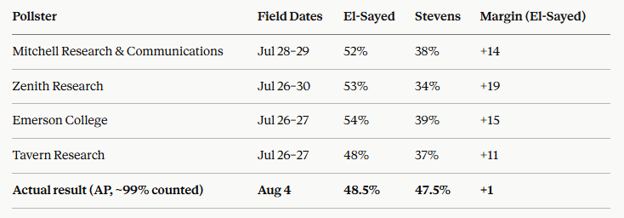
Republicans like to complain that polling is historically biased against them, but in the post-COVID world, polling seems to be wrong in all directions. The Red Wave predicted by nearly all the polls in 2022 never materialized even as Trump has consistently out-performed in his races.
Our friends at the Winston Group have a new video explaining what’s wrong with polling these days – worth a watch.
Count on Divided Government
El-Sayed’s victory yesterday all but assures Republicans will retain control of the Senate next year. The odds of Mike Rogers winning Michigan just shot up sharply and Susan Collins (remember that other progressive, Graham Platner?) is going to win Maine. That would force Democrats to run the table of remaining toss-up races — Alaska, Georgia, Iowa, New Hampshire, Ohio and Texas — to get to 51 votes. Not gonna happen. And if it does, as the New Republic frets, what do they do about Fetterman?
Implications for Tax Policy
Which brings us to tax policy. It’s hard to describe the future direction of tax policy without sounding like Chicken Little, but there you have it.
On the left, the focus used to be on raising revenue to finance an expanded vision of government. Now, they resemble a cudgel crafted to punish anybody they don’t like. That’s largely billionaires and public corporations for now, but the list is sure to grow. Anybody in the wrong industry or on the wrong side of a revolving number of political questions can expect to be targeted.
On the right, the battle is between old school supply-siders, a few remaining traditional deficits hawks, and a new breed of quasi-populists who think they invented mercantilism. Groups like American Compass support raising tax rates on wealthy individuals and corporations, imposing high tariffs that largely fall on the working class, and growing government so they can “invest” in new industries and technologies. How they have the expertise to successfully pick those industries and investments is not exactly clear.
Largely missing from the discussion are people who just want to fund necessary but limited government functions while doing as little harm to the economy as possible.
Conclusion
All this political and policy chaos comes at a moment when our fiscal house is in its worst shape ever. Annual deficits are huge and growing, our national debt is well over 100 percent of GDP, and Social Security is going broke in five years. That all these red flags are flying when the economy is robust and unemployment is low is even more worrisome. What happens with the next recession? Where’s the safety-net then?
Something has to give, and as yesterday’s results make clear, you only need a small minority of Americans to make a big difference. As Reason magazine has pointed out, every over-educated, downwardly mobile voter in Michigan showed up yesterday to support El-Sayed. Will Main Street show up in force this November to counteract them? It’s just our economic future we’re talking about here.